Click on any photograph to enlarge - far superior rendition
In the Autumn of 1965 the most radical design for Rolls-Royce was revealed to the public at the Paris Motor Show. Dealers caught their first glimpse of the car on September 30th and October 1st. The Rolls-Royce Silver Shadow and Bentley T-Series was designed by John Blatchley who produced a far more compact design than the previous Silver Cloud but with as much interior space. Parked beside the present New Phantom and other current models, the Shadow appears dainty and elegant indeed, a car far easier to use and manage in the traffic conditions of 2025.
Being of a monocoque construction with self-levelling suspension and disc brakes it marked the most significant departure in 60 years from the chassis based, coach-built models of the past. From the outset it was designed with the owner/driver in mind. Over a period of more than 10 years, 16,717 Silver Shadows and 1712 Bentley T-Series were produced making it the most successful Rolls-Royce of all time. A much underestimated car.
The original build sheets of SRH 18723 which I retain indicate that my car was completed on February 5th 1974. I purchased it in Wargrave near Henley-on-Thames on 19 May 1987 and paid £12,850 which would be equivalent to £ 36,495 in 2025. Not a great investment in real terms but wonderful in every other way.
The car was part of the fleet owned by the Sultan of Oman, HM Qaboos bin Said (1940-2020) who loved the village and Rolls-Royce motor cars. He was Sultan of Oman from 23 July 1970 until his sad death in 2020. A fifteenth-generation descendant of the founder of the Al Bu Said dynasty, he was the longest-serving leader in the Middle East and Arab world at the time of his death, having ruled for almost half a century.
This explains the 'Royal' registration plate 907 HRH which I have kept. Educated in England and at RMA Sandhurst he took a keen interest in youth projects. As part of an Omani Evening in 1985, he contributed an 'Arabian Feast' together with a group of fully costumed ritual Royal Omani Sword Dancers and Musicians to the Wargrave Festival.
The Sultan bought the Manor of Wargrave and the title in 1973. He did not live there but his mother and some of his wives did until she died. They used the cars and he was also chauffeured in them on his visits. The manor was also a horse stud where he bred thoroughbred Arabians.
On 3 April 2015 the Prime Minister Mr. David Cameron spoke on the telephone to Sultan Qaboos of Oman following the recent agreement reached in Lausanne between the E3+3 (China, France, Germany, the Russian Federation, the United Kingdom, and the United States) and Iran. Cameron thanked him for the key role he played at the beginning of the process. There is a strong and hopefully enduring relationship between the UK and Oman.
 |
The Sultan with The Queen and Duke of Edinburgh on a state visit to Oman, 2010 |
The car presently resides permanently with me in Warsaw.
I have now owned 'Roland' for 40 years
 |
Ideological Conflict - a noble RR Silver Shadow sets off Stalin's Monolith known as the Palace of Culture and Science, Warsaw |
 |
Wargrave Manor nr. Henley-on-Thames where SRH 18723 used to reside. A large country house in landscaped park dating from the late 18th century and altered in the 19th and 20th centuries. |
 |
The rather more modest Bauhaus landscaped estate in Warsaw where the car now resides |
 |
907 HRH and Michael at the Mazovian Ducal Castle of Liw on the former Russian Polish Frontier |
 |
The Silver Shadow before the entrance to the Citadel, Warsaw |
Below you will find an entertaining and informative chapter from my literary travel book about Poland entitled A Country in the Moon. The text deals with an international Polish car rally in 1993 in which I took part - the first international rally here since 1913.

A Rolls-Royce Phantom II was used by the Polish revolutionary and Chief of State of the Republic of Poland, Field Marshal Józef Piłsudski. The controversial Commander-in-Chief of the Polish Armed Forces, Marshal Śmigły-Rydz, reviewed troops and cavalry regiments in a Phantom II All weather Tourer until the Soviet invasion of 1939. He once memorably remarked of Poland's grim destiny ' Germany will destroy our body; Russia will destroy our soul' (Quoted in Poland’s Politics: Idealism versus Realism A Bromke [Cambridge, Mass 1967] 26)
An account of the 1993 rally around Poland from the book I wrote about the country entitled A Country in the Moon (Granta, London 2008)
http://www.michael-moran.net/poland.htm
The financial management training programme of which I was the Project Manager began to disintegrate for various complex reasons associated with the many rapid changes in society that accompanied the fall of communism in Poland in the early 1990's. The Swiss educational foundation that employed me found the learning curve in East-Central Europe rather steep. They considered that the Poles had begun to over-extend themselves.
I decided to distract myself from dwelling on the slow death of the contract with an adventure and decided to take part in an international car rally around Poland - the first since 1913. My friends, mechanics, family - in fact anyone at all - thought I was insane to take the Rolls-Royce to Poland that summer - a modestly priced and completely underrated touring vehicle with a capacious boot and luxurious interior not unlike an Edwardian library. The 1974 Silver Shadow SRH 18723 in Shell Grey with light blue leather is unmolested and has never ‘failed to proceed’ in ambient temperatures ranging from 40C to -25C.
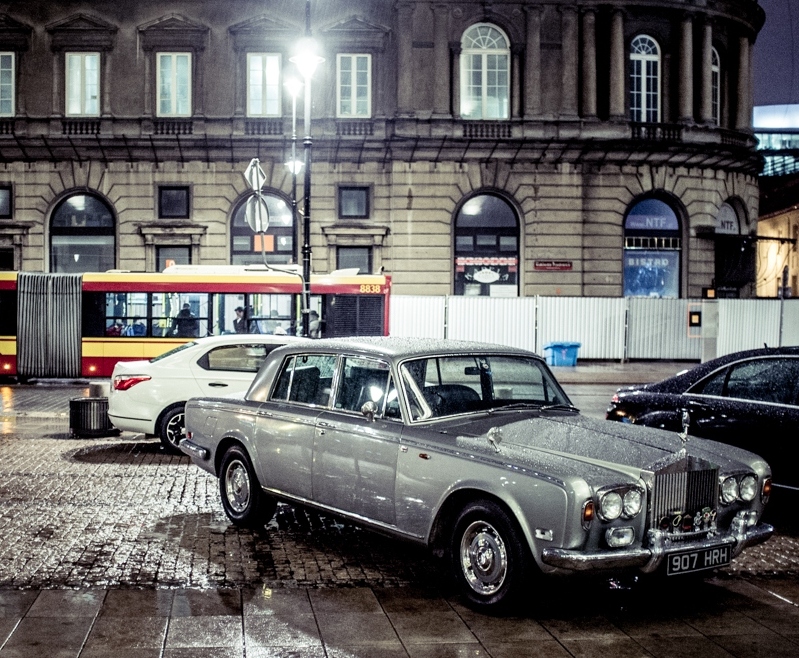 |
SRH 18723 in Central Warsaw |
But adventurous ideas of past Polish glamour had taken over. I had read the romantic story of one of the greatest Polish national heroes, General Władisław Sikorski, driving his rakish 1938 Vanvooren Rolls-Royce Phantom III drophead coupé out of Poland through Romania to Paris ahead of the German invasion in 1939. He was to take up the position of Prime Minister of the Polish Government in Exile in the French capital before relocating to London.
This magnificent drophead coupé chassis 3CM 81 has a dashing two-seater body by the glamorous coachbuilder Vanvooren of Paris. The first owner was one Stefan Czarnecki but according to a Sotheby’s catalogue of May 1969 the car was built to the special instructions of General Sikorski and delivered to him in Warsaw (The Derby Phantoms Lawrence Dalton, RREC 1991 p394). It is now magnificently restored and resides in England.
A Rolls-Royce Phantom II was used by the Polish revolutionary and Chief of State of the Republic of Poland, Field Marshal Józef Piłsudski. The controversial Commander-in-Chief of the Polish Armed Forces, Marshal Śmigły-Rydz, reviewed troops and cavalry regiments in a Phantom II All weather Tourer until the Soviet invasion of 1939. He once memorably remarked of Poland's grim destiny ' Germany will destroy our body; Russia will destroy our soul' (Quoted in Poland’s Politics: Idealism versus Realism A Bromke [Cambridge, Mass 1967] 26)
 |
Winter in wonderful traffic-free days 39 years ago near Zelazowa Wola, the birthplace of Fryderyk Chopin |
Excuse the whimsical formatting as the text below refuses to transfer accurately from the book proof to this posting
An account of the 1993 rally around Poland from the book I wrote about the country entitled A Country in the Moon (Granta, London 2008)
http://www.michael-moran.net/poland.htm
CHAPTER 18
‘Not Upon the Polished Roads of
Their Makers’ Intention’
–T.E. Lawrence (‘Lawrence of Arabia’) on Rolls-Royce Staff Cars in the Desert - Seven Pillars of Wisdom
‘Na zdrowie, Mike! Good vodka!’
‘Na zdrowie!’
I downed another shot of my home-made Żubrówka vodka. I was sharing it amongst the other drivers of the Polish Automobile Club as we were interviewed under bright lights.
‘Who is the President of the club?’ I asked naively. They looked at each other aghast.
‘Are you the President, Witek?’ one driver with a ponytail asked.
‘No, I’m not.’
‘Are you, Staś?’ This questioner looked like Orson Welles in a
Bugatti T-shirt.
‘No. Not me.’ Everyone looked nonplussed.
‘We don’t know who the President is and we don’t care! We are all leaders here! Do you want to be the President?’
I declined graciously.
Upon returning to Warsaw the problem of parking the old Rolls somewhere safe had become painful and I enlisted the assistance of the automobile club. They promised a space in the Technical Museum as an exhibit, but as usual it required a number of obstacles to be surmounted, not the least of which was the moodiness and whimsical nature of the curator.
‘Perhaps he will decide against your car, Mike. You must contact him every time to go out and he may decide against it every day.’
214 A COUNTRY IN THE MOON
There was a faint possibility of parking in the basement of the former communist party headquarters.
Zosia’s husband generously offered me the use of a cramped underground parking space in the centre used by the official drivers of his ministry. Double steel doors led from the street to a courtyard and a red and white striped boom barrier. The guard lived beside it in a shack. A steep ramp led down to another padlocked steel door and a bunker about fifty metres below street level. The car was perfectly safe and I could have free access provided my romantic assignations with Zosia were never discovered. I dreaded to think of the outcome of Polish vengeance on my beautiful machine. I also felt morally uncomfortable about the whole situation. However, I put any reservations well to the back of my mind as there was no other viable alternative.
The first classic car rally around Poland for eighty years was to begin the following week and I had decided to take part. The last international event of this type was won in 1913 by Count Konstanty Broel-Plater in a valveless Benz. The Poles had an illustrious record as racing drivers long before the exploits of their fighter pilots. GP Bugattis were extensively raced in Poland by the wealthy aristocracy in the 1930s at the Lwów Grand Prix (now L’viv in western Ukraine) and in the Tatra Race in the Carpathian moun- tains. The female Polish grand-prix driver Maria Koumian drove her Bugatti to particularly glamorous public acclaim. In 1952 the Italian ace Rudolf Caracciola was interviewed at Monte Carlo. When asked which tracks he found most difficult, he answered: ‘Definitely Nurburgring, next Monte Carlo, but no . . ..Lwów, yes Lwów in 1932 . . . It was a difficult route, Monte Carlo is a mere velodrome. I remember Count Potocki, oh . . . it’s an old story . . .’
The economic depression of the 1920s did for these great races but failed to demolish the élan of the drivers. The most famous Polish driver of the era was Count Louis Zborowski who raced at Brooklands in the 1920s and lived splendidly in the Palladian stately home Higham Park in Kent. He competed in Bugattis, Aston Martins and his own aero-engined monsters designed with his engineer Clive Gallop, one of the original Bentley Boys. He called each of the four examples of this car Chitty Bang Bang. Ian Fleming was inspired to write the story of the magical car Chitty Chitty
‘Not Upon the Polished Roads of Their Makers’ Intention . . .’ 215
Bang Bang based on the Polish Count’s romantic exploits the day his son remarked to him, ‘Daddy, you love James Bond more than you love me.’147
Some sixty historic cars and motorcycles including marques seldom seen by Westerners set off from Warsaw on a course of 1500 kilometres. Richard was to act as navigator and my son Alexander had flown in from Lisbon to bolster his father’s wavering resolve. We had first to complete a few bizarre driving tests in Piłsudski Square near the tomb of the Unknown Soldier – balancing the car on a pivoting platform and driving blind in a straight line with a green bag over the driver’s head. The reception south along the Vistula was tremendously enthusiastic with people lining the roads throwing rose petals as if we were in the Mille Miglia road race.
‘Piękny! Piękny!’ (‘Beautiful! Beautiful!’) they called as I drove by.
 |
| The Rally takes a break at the picturesque and historic town of Kazimierz Dolny on the Vistula River not far from Warsaw |
The appearance of a neo-Gothic fantasy castle announced our arrival in Lublin, a city of rich intellectual, religious and cultural heritage. As is customary in Poland the Old Town is surrounded by sterile communist concrete. The Nobel prize-winning novelist Isaac Bashevis Singer paints an eloquent portrait of nineteenth-century Lublin in his powerful novel The Magician of Lublin.
The dusk descended. Beyond the city there was still some light, but among the narrow streets and high buildings it was already dark. In the shops, oil lamps and candles were lit. Bearded Jews, dressed in long cloaks and wearing wide boots, moved through the streets on their way to evening prayers. A new moon arose, the moon of the month of Sivan. There were still puddles in the streets, vestiges of the spring rains, even though the sun had been blazing down on the city all day. Here and there sewers had flooded over with rank water; the air smelled of horse and cow dung and fresh milk from the udder. Smoke came from the chim- neys; housewives were busy preparing the evening meal: groats with soup, groats with stew, groats with mushrooms . . . The
147 In the film the name Chitty Chitty Bang Bang comes from the noise the car makes. Actually Count Zborowski named his cars after a bawdy soldiers’ song from the Great War concerning officers based in France. They would obtain a weekend pass known as a chit to go to Paris and enjoy the delights of certain accommodating ladies. The unusual name Chitty Bang Bang is thus readily explained.
216 A COUNTRY IN THE MOON
world beyond Lublin was in turmoil . . . Jews everywhere were being driven from their villages . . . But here in Lublin one felt only the stability of a long-established community.
This original medieval trading city gave rise to its own characteristic form of Renaissance architecture and was one of the most important centres of Jewish life in Europe. Most importantly it witnessed the signing of the Union of Lublin which established the Polish–Lithuanian Commonwealth in 1569. In many ways this republic embodied at a much earlier date similar political ideals to those that inspired the formation of the European Union. It brought together democratic principles, civil rights, constitutional law and remarkable religious tolerance in the finest of political orders. In 1939 almost a third of the total population of Lublin were Jewish. The largest Talmudic library in the world was located here and a famous Yeshiva (high school) was staffed with distinguished refugee Jewish teachers from all over Europe.
The scenes of innocently integrated civilization were swept away forever by the horrors of nearby Majdanek concentration camp. One exhibit in the fine museum is a barrack block crammed to bursting with the discarded shoes of Jews. Without signage or commentary, choking with stale odour, this silent testimony to horror is the most eloquent I have seen in Poland. Clouds of black ravens nest in the trees, squawking raucously and drifting above the camp like ashes carried by the wind. A synagogue has recently been renovated in the city within the elegant yellow-ochre old Yeshiva building where scholars used to study the Talmud. Exhibits for a museum are being collected mainly from Christian Poles who preserved sentimental objects owned by murdered Jewish friends – a silver ladle, some broken candlesticks, a powder box kept for sixty years by an old lady. The mass killing of Jews was regarded by a majority of Poles as a sign of the depravity of the German conqueror. An unremarked solidarity existed in the face of this common enemy as Poles waited in fear of their own genocide. Scarcely any traces now remain of the Jews of Lublin. Their absence haunts ancient courtyards, their ghosts lean over the old wooden balconies.
The modern city is one of the most vibrant and attractive I have encountered in the country. The reconstruction of
‘Not Upon the Polished Roads of Their Makers’ Intention . . .’ 217
magnificent Renaissance town houses in the winding warren of streets and old squares is proceeding apace. In summer the streets and sidewalk cafés teem with Mediterranean bustle. A Jewish pub called Mandragora has been opened by a woman with Jewish roots who enthusiastically maintains many ceremonies associated with the culture and imports spices from Israel. The Catholic University of Lublin is the only such institution in East Central Europe and during the communist period remained a repository of Polish Catholic culture.
The following morning I turned the Spirit of Ecstasy towards Zamość, the città ideale of the Late Renaissance known as the ‘Padua of the North’. An old wood-block print of this star-shaped fortified capital of the estate of Grand Hetman Jan Zamoyski had fascinated me since I had first seen it in the window of a Warsaw antique shop. We left Lublin early, mist rising from the fields, the landscape polished by moist light. The Lublin Upland is a largely unspoilt agricultural region between the Vistula and the Ukrainian frontier in the east, part of the European latifundia or great grain estates.
The old car was performing immaculately, wafting characteristically through the countryside with no apparent motive force. The quilted meadows were dressed in summer green. Enormous twin-spired parish churches dominated the flat landscape but one searched in vain for the village that financed their construction. Many single horses, a few harnessed in pairs, ploughed the fields. Surprisingly elderly men plodded behind the animals with the traces slung around their necks, grasping an implement of primitive design, pushing it deep into the earth. Women with their heads wrapped in colourful scarves were sowing seed in an ancient biblical manner, grasping a handful from a hessian bag and casting it in an arc with a wide sweep of the arm. Men dropped potatoes into furrows. These ancient Polanie or people of the fields unbend from their work to rise up in silhouette against the wide sky and clumps of birch and willow to gaze vacantly at your passing. I stopped at a village to buy warm fresh bread for breakfast.
No amount of reading prepared me for the exalted architectural impact of Zamość. The town was surrounded by characterless communist concrete but the elegant Baroque spire of the Old Town led me forward. Zamość is the perfect embodiment of the Polish
218 A COUNTRY IN THE MOON
Renaissance-Mannerist style. The sides of the square are some one hundred metres long, lined with Renaissance houses above vaulted arcades with wrought-iron lamps and plasterwork. They provide cool shade in summer and protection from the severe winter. At night the square was eerie and mysterious with the galleries fitfully illuminated by gas lamps in the shadow of Renaissance pediments. The folk decorations of the Armenian merchants’ houses were transformed into grotesque shapes that seemed to possess veiled threats. Hurrying silhouettes were muffled against the chill. Today the architectural spaciousness of the piazza has disappeared under a welter of sponsored brewery umbrellas and alfresco dining.


The city was designed and built in the late sixteenth century by Bernardo Morando of Padua as a work of art and the capital of the estate of Grand Hetman (Commander-in-Chief) Jan Zamoyski (1542–1605), head of one of the most illustrious Polish magnate families and arguably the most powerful Pole in history. A noble Sarmatian portrait of the Chancellor, a man of profound humanist learning who assembled one of the great libraries of Europe and studied at the University of Padua, hangs in the museum.
The city is an expression of the platonic ideal of community life built according to Italian Renaissance theorists intended to reflect the order of the cosmos, the divine music of the spheres. In the sixteenth century the market would have teemed with Jews, Armenians, Turks, Magyars, Ruthenians, Greeks, Italians and even Scotsmen as well as Poles. The city was on an important crossroads on the trade route through Lwów linking Northern Europe with the Black Sea. The city is a perfect realization of the Palladian bello secreto of musical harmony and architectural form. For this illustri- ous magnate, the capital of his ‘kingdom’ (half the size of Belgium) combined a centre of commerce and habitation, a massive fortress, a cultural academia (university), a place of religious observance and finally his residence. This ‘Latin’ capital is a unique survival in Europe.
The town was one of only two fortress cities that managed to withstand the Swedish sieges in the mid-seventeenth century. Although once an important trading hub, today Zamość struggles economically with unemployment as it is no longer on the way to anywhere. Colourful washing made bright splashes of colour above
‘Not Upon the Polished Roads of Their Makers’ Intention . . .’ 219
vegetable gardens in Italianate courtyards. Dogs and chickens rooted amongst the wrecks of old American cars. The Zamoyski Palace was turned into a military hospital in 1830 but is now being restored, the equestrian statue of Jan Zamoyski re-erected.
The Poles in the region around Zamość suffered a terrible fate during the Second World War. It was designated the ‘First Resettlement Area’ of the Generalgouvernement of the Nazis. This ‘ethnic cleansing’ resulted in the resettlement, execution and torture of some 110,000 Polish peasants and the clearing of hundreds of villages. Thousands of Polish children were dragged from the arms of their screaming mothers to be brought up with a new racial identity as Germans. The town was renamed Himmlerstadt and intended to be an outpost of German culture in the east. The Jews were trans- ported to Bełżec and Sobibor extermination camps.
Mounted police fell like a pack of savages on the Zamość Jewish quarter. It was a complete surprise. The brutes on horseback in particular created a panic; they raced through the streets shouting insults, slashing out on all sides with their whips. Our community then numbered 10,000 people. In a twinkling, without even realizing what was happening, a crowd of 3,000 men, women and children, picked up haphazardly in the streets and in the houses, were driven to the station and deported to an unknown destination. The spectacle, which the ghetto presented after the attack, literally drove the survivors mad. Bodies everywhere, in the streets, in the courtyards, inside the houses; babies thrown from the third or fourth floor lay crushed on the pavements.148
Thousands of Polish citizens of the town, including many children, were executed in the Rotunda, a nineteenth-century gunpowder magazine constructed by the Austrians. It lies in a memorial park south of the defensive walls. The road crosses the inevitable railway tracks near the local station and shunting yards. The building is a brick drum with an open arena in the centre covered in cinders. There are cells within the circular walls that are dank and dark,
148 David Mekler quoted in Zamość Ghetto Aktion Reinhard Camps (http://deathcamps.org)
220 A COUNTRY IN THE MOON
reeking of evil and death. Many candles burn before memorial sculptures but no cosmetic restoration has taken place here since the war. The damp mould of decay catches in the throat as one wanders about, spirits sinking lower and lower. The arena is entered through the original Nazi wooden and barbed-wire gate painted with gothic German script. Through the barred apertures one can see today’s children laughing happily in the sunshine, paddling in the nearby lake, and running along paths dusted with wildflowers. The presence of the black night of the soul directly beside the golden achievements of the Renaissance is a haunting and profound mystery. Poland is unique in these displays of light and utter darkness.
By chance we had arrived during a memorial service. The Polish Air Force provided a guard of honour. Cinders crunched ominously underfoot. Torches were lit around the memorial as dusk descended. Carbines were raised and the live rounds fired with a tremendous flash, smoke and deafening roar, the reports tearing off the walls in a terrifying amplified explosion that reminded one in a physical way, like a punch to the abdomen, of Nazi executions. The brick drum concentrated the sound painfully, acrid smoke filling the nostrils, brass cartridge cases spinning into the cinders. I circled the Rotunda looking at the forest of white crosses and the plaques denoting the camps where the citizens of the ‘Padua of the North’, the noblest expression of Renaissance humanism, had been brutally exterminated.


From Zamość the rally passed through the Roztocze National Park, the last home of the small, wild Polish horse called the Tarpan. Sitting in the centre of open field covered in yellow dandelions was a tiny, blonde Polish girl with a red ribbon in her hair making a crown of cornflowers and buttercups. A shaft of sunlight fell through a gap in the trees creating a golden halo around her head. Two peasant farmers without teeth engaged me in conversation and leaped backwards into a pond in rustic surprise when I said I was from Australia. The forests of huge fir trees (the largest in Poland with a height of 50m) and magnificent Carpathian beeches give way to spruce, oak, hornbeam and aspen. The superb lakes support a huge variety of water-birds. There is an untouched wildness about the landscape of the eastern borderlands of Poland that is intensely romantic in its solitude. Yet in the midst of this natural lyricism
‘Not Upon the Polished Roads of Their Makers’ Intention . . .’ 221
tragedy so often lurks. I came upon a car that had passed me at suicidal speed and which had now left the road and slammed into a tree-trunk. The driver was slumped unconscious or dead over the wheel, his face crushed and bleeding, his young wife or girlfriend sitting by the roadside looking at him and weeping – an awful irruption of reality into my dreams. I stopped at a nearby farmhouse and with great linguistic difficulty called an ambulance.
Some sixty kilometres from the Ukrainian border we reached the great palace of Łańcut which also lies on an ancient trade route from Western Europe to Ruthenia. After the ‘cynical surgery’ of the third partition of 1795 this area became part of the Austrian province of Galicia. We were directed to the usual rotting former communist accommodation functioning at that time as a violin summer camp. Łańcut hosts a famous annual music festival. What a contrast between the beautiful melodies floating from open windows and the dead flies in our freezing room, the urine running across the floor from the broken pipes and blocked drains of the communal bathroom. This type of accommodation has happily almost completely disappeared.
The crush of people around the cars obscured one of the grandest aristocratic residences in the country and one of the most remark- able in Europe. The palace was one of the few magnate residences relatively untouched either by the war or the communist period. In the late sixteenth century a fortified country house stood on the site, the stronghold of the brigand Stanisław Stadnicki known as ‘The Devil of Łańcut’ for his reckless and predatory behaviour. In the mid-seventeenth century the fabric was altered and expanded into a palazzo in fortezza by the fabulously wealthy Lubomirski family. During the Polish Commonwealth they were said to own 360 towns and possessed greater wealth than many European royal families. The ubiquitous Dutch baroque architect Tylman van Gameren modernized the castle, adding the baroque towers with great copper-sheathed cupolas as well as strengthening the fortifications against the Turkish threat.
Elżbieta Lubomirska née Czartoryska was one of the wealthiest, most beautiful and cultured women in Warsaw although she suffered from ‘excessive sensibility’ and a neurasthenic disposition. Later in life she spent her time at Łańcut ensconced on a chaise
222 A COUNTRY IN THE MOON
longue in a darkened room with her migraine headaches ministered to by a graceful young Turk. She had shared a sentimental and intellectual intimacy with the young Stanisław Augustus Poniatowski (the last king of Poland) and thoroughly put him through the grinder of jealousy and romantic despair. He wrote mawkishly in his Mémoires: ‘she seemed to belong to a superior order of being’.149
 |
| The Gardens of the Palace of Lancut |
Łańcut is reminiscent of a large English country house but rather more stylish and certainly less straight-laced. Elżbieta transformed the castle into a grand palace worthy of one of the greatest magnate families. A large garden was laid out in the English style and a Florentine artist created a sculpture gallery that displays Roman busts and antique marbles covered by a superb trompe l’oeil sunlit pergola covered in vines. Elżbieta’s adopted son Henryk Lubomirski appears as an androgynous, cosmetically voluptuous sculpture of Amor carved by Antonio Canova. The Turkish suite pulsates in enthralling red, an opulent orientalism casting one back to the Sarmatian heritage of seventeenth-century Poland.
Elżbieta was a good musician and employed an Italian composer and a pupil of Haydn to be the Kapelmeister of her private orchestra. She created an exquisite private theatre and staged French plays by Marivaux and sketches (or ‘Parades’) written by her son-in-law Jan Potocki (1761–1815). This character straight from fiction was an ethnographer, linguist, early balloonist, mystic, oculist and author of the astonishing Manuscript Found in Saragossa, a labyrinthine weave of exotic and fantastical tales told by a young army officer.
The Potockis inherited the palace in the early nineteenth century and it ‘became a byword for slightly vulgar show and manic entertaining’.150 Emperor Franz Josef II, Afghan monarchs, Romanian princesses, Daisy von Pless, Madame de Staël and the Duke and Duchess of Kent were all house guests for foxhunts and shooting in company with assorted politicians, celebrities and the wandering refugee aristocracy of France. My concert pianist grand-uncle had taken a few lessons from the great musical pedagogue Theodor
149 My account of Elżbieta Lubomirska is derived in part from the superb The Last King of Poland
by Adam Zamoyski (London 1992)
150 Poland: A Traveller’s Gazetteer, Adam Zamoyski (London 2001) p. 132
‘Not Upon the Polished Roads of Their Makers’ Intention . . .’ 223
Leschetizky who was born in the castle in 1830, his father being music master to the Potockis. In Vienna he was the renowned teacher of some of the greatest pianists of the age including Ignacy Jan Paderewski, Ignaz Friedman and Artur Schnabel.
The unique carriage museum has, next to a collection in Paris, the most extensive assemblage of private equipage in the world, including the elegant calèche reputed to have been used by Chopin. Sleighs of basket-work, gilded and upholstered in green velvet and deeply lined with fur, remind one of races across the winter ice in the novels of Pasternak or Tolstoy. The walls of the museum are ornamented with hunting trophies, including a rather unpleasant giraffe severed mid-neck and mounted vertically. The Potockis retained the palace until 1944 when the dashing Alfred Potocki was forced to load 14 railways freight cars with precious objects and dispatch them ahead of the Soviet Army to Vienna, Lichtenstein and finally France. They were related to nearly all the crowned heads of Europe, which ensured the survival of the palace (assisted by a sign hung on the gate reading National Museum), but the communists forbade the return of its treasures to Poland. Despite the depredations of war Łańcut gives a unique and breathtaking intimation of the splendour and wealth of Polish magnate families.
We were treated to a fine chamber music concert in the Sala Balowa the first evening as part of the annual music festival. A number of priests, bishops, and archbishops had chosen to attend a performance of Pergolesi’s Stabat Mater and Tchaikovsky’s Souvenirs de Florence. The elderly Princess Potocka was present but seemed rather distraite. In this beautiful Aigner ballroom I could imagine an elegant past audience of Polish officers, ministers, artists and revolutionary writers dancing with radiant women in silk and jewels as guests of the Potockis. My body aching from a fast and reckless morning ride on their hunting estate near Julin was now bathed and relaxed. Under the chandeliers listening to a sentimental Wieniawski Polonez with the keenest pleasure, I recalled the forest rushing past, the pounding of hooves, the slight fear of the unknown as I too dreamed of a Polish mistress.
Early next morning we left Łańcut. The rally was heading into the far east corner of the country and suddenly took an
224 A COUNTRY IN THE MOON
unsealed road outside of the town. At the bottom of an incline, the ruts and undulations of a dry stream bed appeared to present no particular danger. I overcooked my approach speed and the car violently bottomed. The unmodified suspension is rather soft and I was forever clouting obstacles – hidden spikes, stones, culverts. A frightful roaring came from the engine. The underside was intact but I had struck a rock and broken the left bank of the exhaust manifold at the elbow. Experience has taught me that although they are strong, nothing is simple to repair on a Rolls-Royce. We were 900 kilo- metres east of Berlin and in deep trouble. Some Polish children, as usual, broke my despair.
‘Excuse me, sir. Can we take a picture of your beautiful car?’
The rally support vehicle led the car like a wounded lion, growling and vengeful, to a local mechanic in the town. A man was welding a pair of enormous wrought iron gates from the Potocki palace. Sundry dilapidated sheds contained a riot of ancient lathes and other metal-working machines. His round, fresh-faced wife immediately offered me a hearty bean stew. I was despondently hunched over a bowl of it in the kitchen lamenting our lot with my son Alexander when Richard came in.
‘Michael. Good news, old chap. There is a Polish mechanic down- stairs who worked on Rolls-Royce cars in Chicago.’
‘Get out! I’m in no mood for jokes,’ I shouted ill temperedly.
‘No, I’m serious. He repaired the car owned by the mayor of
Chicago.’
‘Richard, will you please stop torturing me and go away!’ Jan the mechanic stood in the doorway of the farmhouse. He was a gangly, hyperventilating man with a cracked spectacle lens and a comforting smile who told me he ‘spoke American’.
‘No big video! I fix mayor of Chicago Royce-a-Rolls when mafia blow him up with a bomb. No big deal this repair. Józef he help me. No big video!’
The man working on the gates wandered in our direction and silently crawled under the car. Jan clearly knew a great deal about the rear of the vehicle where the bomb had exploded but seemed less certain about the engine compartment. Anyway it was now well out of my hands. The Poles had taken over. The repair become a question of national pride. Correct size tools were the main problem as
‘Not Upon the Polished Roads of Their Makers’ Intention . . .’ 225
my carefully assembled English set had been stolen in the Poznań robbery. The rally had continued on south towards the town of Sanok and left us to our own devices. The two-way radio of the Kommandor suddenly squawked.
‘Krzysztof?’
‘Yes. What’s up?’
Squawk.
‘It’s Konrad. Where are you?’
‘120 kilometres from Łańcut. Why are you asking?’
Squawk.
‘We need some English tools for the Rolls-Royce immediately!’
‘OK. I’ll bring them in a flash! Like bringing blood to the wounded!’
Darkness. Torrential rain of a wild Polish summer storm. Vodka. Five men push a heavy car half into an ill-lit garage with a chicken coop and a crazy tethered Pekinese. The tools arrive but none fit the bolts as they have rusted slightly smaller over the years.
‘No big video, Mike! My cousin has a factory and will make tool for us. I will measure with micrometer. We go home now for dinner. You sleep my place! It will be big party!’
We returned to his modest home for a vast meal which confirmed with a vengeance the adage that in Poland guests are considered ‘God in the house’.
The next morning after a huge breakfast we returned to the garage and the tool was duly delivered. Its handmade appearance looked none too promising but it fitted perfectly. Each bolt was first hit a terrific blow with an iron bar and sledgehammer to loosen it. I became nervous indeed of the beautiful machine and moved from foot to foot with a furrowed brow.
‘Go eat apricots from tree, Mike. You are make me nervous! Stop looking and worrying. We done this to Russian diggers and tanks. No big video!’
Mechanics seemed to be arriving from all over Poland to work on the car. Giving unsolicited advice is a Polish trait that can be helpful but can often be conflicting. Two Poles and three opinions, it is said. The exhaust manifold was soon off and they hot-welded the cast metal after truing up the faces by eye on a grinding wheel. An art in itself. Russian tank gaskets were trimmed and glued to the faces.
 |
Jan and Józef hot welding the cast iron exhaust manifold, faces trued by eye |
226 A COUNTRY IN THE MOON
The repair came together perfectly and by late afternoon the work was finished.
Jan was descended from Austrian stock who had inhabited Łańcut for many generations. While talking of the large number of priests in his family he took me on a tour of the ‘hidden’ town. First to the parish church where both mechanics had repaired icons, crosses and gates. The seldom visited dusty tombs of the Potockis were shown us by an old lady in headscarf, thick woollen socks and clogs. Then to the presbytery of a priest who had courageously concealed Solidarity activists hiding in the nearby forest in the crypt of his three-hundred-year-old wooden church. He had been arrested and tortured many times during martial law but had never become a collaborator, unlike many priests whose shady pasts are now being revealed. He lifted a lighted candle aloft for me to inspect the ancient polychrome decoration in the cavernous roof. This intelligent, articulate and handsome man with a hint of subversiveness was clearly a character from an unwritten Graham Greene novel. He had many pretty female callers while we drank tea, vivacious young ladies who became innocently flirtatious in his company.
Another celebratory night followed.
In the morning we were packing the car and about to leave when a voice erupted from the house.
‘You don’t leave, Mike! You must wait my brothers.’
I was getting impatient to rejoin the rally that was now hundreds of kilometres distant and camped by a lake. We waited. Seated in the car and poring over a map, I suddenly felt drops of water falling on my face. I thought it was raining. I looked around to see two priests, Jan’s brothers, dressed in surplice and soutane, blessing the car with holy water.
‘We come to bless your car for safe journey!’
Richard, Alexander and I were still not permitted to leave until we had consumed yet another enormous lunch. Some of my favourite Polish food appeared – żurek (sour rye flour soup with sausage and hard-boiled egg), naleśniki (pancakes with sweet or savoury filling), the fantastically popular pierogi ruskie (dumplings shaped like ravioli filled with savoury cheese served with chopped fried smoked bacon. The sweet variety with blueberries and slightly sour cream are superb) and bigos (a ‘hunter’ stew of sauerkraut and
‘Not Upon the Polished Roads of Their Makers’ Intention . . .’ 227
various types of meat, sausage and mushrooms). The meal concluded with coffee and pączki (a closed doughnut with sugar glaze filled with rose-flavoured jam).
An unaccustomed joy entered the proceedings. Jan and Józef charged us nothing for the repair or the two full days accommodation and food. We had experienced some of the finest qualities of Poles – emotional warmth and support in distress, solidarity, overwhelming hospitality and acres of food, the ability to improvise solutions in impossible circumstances and a final flourish of the Catholic Church. A big video indeed
The Rally continued around the beautiful south-east corner of Poland – pine and birch forests, pristine lakes, the craggy limestone crags of the High Tatras, magnificently sited castles and of course culturally rich Kraków. It concluded in Warsaw.
We were the first to arrive back at the Stadion Dziesięciolecia in Praga, which was a definite mistake. As it often happens in Poland, publicity for the event had been poor. There were no spectators and plastic cups of warm sparkling wine made the conclusion a mild anti-climax. The adventure of Łańcut was retold through loudspeakers to an empty stadium. The competitors did a lap of honour. In a doleful moment a man pushing a disabled youth in a wheelchair with enormous effort lifted him up to the driver’s window of my car so that he might see the interior.


Flurries of emotion alerted me that something was wrong when we returned to the Ośrodek. Two of the classic car transport vehicles that had been parked there while we were away had been stolen together with the trailer that had brought the BNC racing car.
There was a high degree of embarrassment all round but it scarcely surprised me. Car theft was of epidemic proportions in those days, but is far less prevalent now with millions of imported second-hand vehicles on the roads. During the ball which concluded the Rally I realised through a deep haze of vodka that I was being awarded some sort of prize. I had come second in the timed driving tests, the Silver Shadow placed between an MGTF and an MGA. Another surprise was the extraordinarily generous gift of a replacement DKW to the competitors who had wrecked theirs in the ravine. As often in Poland emotions swing on a pendulum – two cars lost and one given.
 |
| The superb BNC Voiturette Apart from Bugatti, Amilcar, and Salmson, the best-known small French sports car of the 1920s is surely the Bollack, Netter et Cie., or BNC. |
And so the first Rally around the country for 75 years concluded: an adventure unlikely ever to be repeated in quite the same way. The exploration of a reborn nation of romantic landscapes and magnificent castles; the adrenalin of driving a great car on the deserted Polish roads of those days, far from help and without insurance; a lucky escape at the Palace of Łańcut; new Polish friends with their amazing hospitality and support in adversity – such experiences are given to few.
The Polish edition is obtainable directly from the author mjcmoran@wp.pl

A happy couple celebrate their 50th Anniversary in Poland
[1974 Royce Silver Shadow and 1968 MPW Royce Two-Door Convertible]
